The following is the third and final part in a series about the state of the Oakland University basketball program. So often such addresses are delivered by the heads of state (or in this case, the program), but for today this is from the perspective of an outsider, a dedicated fan.
Being a sports fan is inherently about community. We express our fanaticism for our favorite teams by wearing clothes, attending games, joining forums, reading analysis and recaps, and - in some cases - writing about the experience ourselves. All of these things connect us to other supporters of the team. The shared interest flows from one fan to the other, it spurs conversation, and ultimately makes us happier individuals.
For college basketball, a strong community of supporters is absolutely essential in developing a happy program. When fans don school colors, the school wins from increased exposure. When fans attend games, it helps bring in much-needed revenue. When fans talk about the games and read the recaps, it makes it possible for a local paper to support a beat writer who in turn exposes the program to wider audiences. And when all of these combine, the program can do wonders not just for itself, but for the stature of the university as a whole, too.
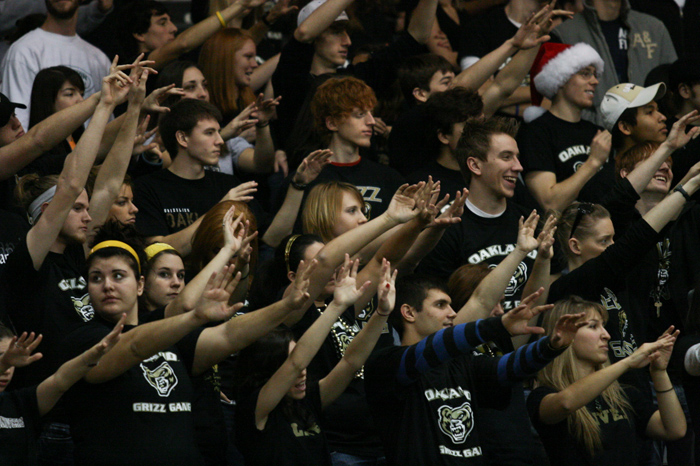
Fortunately, at Oakland University all of these facets have been coming together nicely over the past few seasons. University apparel has been made available at nearby supermarkets, and local businesses have slowly embraced the university's swag. Students, while never lacking the opportunity to obtain a free shirt at OU, still have a tendency to wear gear from other universities, but progress has been made at games and especially while in the student section. Black-outs have become the norm for students at big games, evidenced at last season's homecoming game against Oral Roberts.
Attendance figures as a whole have been great the past few seasons. The average attendance was steady in the mid-2000s before surging in the 2008-2009 season due to two games at the Palace of Auburn Hills that were counted as home games despite a larger crowd advantage for the visiting teams (Michigan and Michigan State). Still, the increase that season was good enough for second largest increase in the nation, and the opportunity to play home games at the Palace should not be discounted. This past season saw the largest growth sans a Palace game. Average attendance was 2,733, no doubt boosted by increasing student participation as well as community interest in a team that eventually won a conference championship and NCAA tournament bid. The sense of community emanating from the O'Rena is surely something to behold and a strong indicator of the program's current success.
This community sense has also been enhanced by technology. While he's yet to join the Twitter revolution like conference colleague Scott Nagy, Coach Greg Kampe gave fans insight into the team's preparation before every game on OUGrizzlies.com via video updates. For a team that does not receive regular attention on national or regional media outlets, such updates have been key in giving fans the inside scoop so many other schools have the privilege of receiving. Furthermore, the Oakland Press has been instrumental in giving access to fans through the efforts of beat reporter Paul Kampe and Doug Pemberton before him. They have found success in adapting with the times by offering a weekly video interview series known as Grizz Talk on their website. Credit should also be given to the student newspaper which has gracefully fulfilled its role of updating students on news and events regarding the program. Finally, fans have also been involved through a forum that features many dedicated supporters who discuss, analyze, and link to anything going on with the program. All great programs have such outlets for fan expression, and the Grizzlies community has come together to offer one of the best in the conference.
The commitment from administrators, students, alumni, and community members to Golden Grizzlies basketball has been growing over the years. Many will say that 2010's NCAA Tournament appearance was validation that the commitment and emotional investment was worth it. After all, OU was featured on the front pages of the Detroit News and Free Press and on FOX 2, WDIV 4, and Channel 7 throughout the days leading up to the game against Pittsburgh. There were also stories and breakdowns on any number of the national college basketball websites and blogs in cyberspace. And there was a buzz amongst fans on-campus, especially as 100 students boarded buses to attend the NCAA game in Milwaukee where the students, combined with family members, alumni, and other fans, made for a formidable OU support section. It was clearly a good time to be a Grizzly this past March, and the positive effects of that experience should continue to be seen in the future.
---
It is my hope that after reading these last few posts about The State of the Golden Grizzlies basketball that a light was given to some aspects of the program that are sometimes overlooked. I'd never want to bypass the impact that Coach Greg Kampe and the coaching staff, athletics staff, senior administrators, and donors make on the program. But the recent success the program has had in broadcasting, graduation rates, and community-building are paramount to this process as well. As a recent graduate, it is my hope that the OU program will continue on this exciting path which has brought the university more exposure in the local area, the state, and the nation. Most of all, it is hoped that the special community that has grown out of this basketball program can continue to be a rewarding and positive one which fosters more traditions, more friendships, and more everlasting memories.
Showing posts with label The State of the Program. Show all posts
Thursday, May 13, 2010
Wednesday, May 12, 2010
The State of the Program: Part II
The following is the second part in a series about the state of the Oakland University basketball program. So often such addresses are delivered by the heads of state (or in this case, the program), but for today this is from the perspective of an outsider, a dedicated fan.
When the average person attends college, the goal is to obtain a degree. It is presumed that the degree will be valuable in the search for a meaningful and fulfilling job. In the realm of college basketball, however, it is debatable whether this is the true end goal. In the one-and-done era, especially, it has become increasingly common for student-athletes to completely bypass the former portion of that hyphenated word which press conference moderators love so much. These individuals are students only in the sense they are enrolled in classes. But how much time and effort is put into those classes? A recent report showed that such effort is minimal for the University of Kentucky basketball team, which featured four one-and-doners this past season, where the team GPA was just above passing.
The one-and-done phenomenon doesn't affect teams at the mid-major level as much, but there are still factions on such campuses who wonder about the work athletes put into school versus sport. As an Honors student and dedicated supporter of athletics during my time at OU, this was something I thought about on a consistent basis. The Honors student in me valued education first and foremost, but the basketball fan in me knew the athletes were denied certain opportunities I would have because they played Division I basketball. A major part of my time as an undergrad was shaped outside of the classroom by the activities I was involve in, the many communities I joined, and the jobs and internships I was able to partake in. In essence, I had a complete undergraduate experience.
While I'm sure any basketball player will tell you they too had a great experience, there is no doubt that the time they have to dedicate to the program severely limits opportunities: if you have practice during the day, it becomes difficult to secure an on-campus job; if you have summer workout programs, it's nearly impossible to land a summer internship; and if 75% of your non-conference schedule is on the road, well, it is really hard to establish meaningful relationships with professors. These are all things I had the opportunity to do as Joe College Student, and each one of them made me feel more connected to the university, boosted my pride, and eventually led me to spend a lot of time trying to spread that pride and sense of community to others.
The basketball program does that too, and the players are perhaps the most integral part of that process. They sacrifice the typical college experience for grueling practices, long flights, and even longer bus rides to lackluster places like Macomb, Illinois. Don't get me wrong, there are assuredly many perks that make the life manageable; these are gifted individuals with talents better than most who go to school for "free" (and no one is saying they don't have chances to have fun off the court), but it is still worth noting such sacrifices that many students often forget about when debating the merits of the student-athlete education.
What is important noting at Oakland University, as we evaluate the State of the Program, is that the student-athletes are graduating. While it is impossible to show what is behind the degrees they are earning, the simple fact remains that they are getting them. They are walking across the stage each semester with a degree in hand. Three starters from last year's team just graduated in May, making Coach Greg Kampe three-for-three for both his 2006 freshmen class (Johnathon Jones, Keith Benson, and John Kast) and amongst those who stayed with the program in his 2005 freshmen class (Derick Nelson, Erik Kangas, and Ricky Bieszki). Even as one of those players, Keith Benson, tested the NBA waters early (and eventually withdrew), he still had his degree in hand.
We can be sure that after four (or five) years under Kampe, these individuals are graduating as disciplined men. They are proven winners. Some may go overseas to play basketball for a bit while others may stay in the States seeking playing opportunities. But ultimately they'll end up in a position where their Oakland University degrees (and experiences therein) will come in handy. This fact is something all Golden Grizzlies fans should be proud of because there are not many schools that can boast about graduation rates. And it's also one more reason why it is a remarkable time to be a supporter of this program.
When the average person attends college, the goal is to obtain a degree. It is presumed that the degree will be valuable in the search for a meaningful and fulfilling job. In the realm of college basketball, however, it is debatable whether this is the true end goal. In the one-and-done era, especially, it has become increasingly common for student-athletes to completely bypass the former portion of that hyphenated word which press conference moderators love so much. These individuals are students only in the sense they are enrolled in classes. But how much time and effort is put into those classes? A recent report showed that such effort is minimal for the University of Kentucky basketball team, which featured four one-and-doners this past season, where the team GPA was just above passing.
The one-and-done phenomenon doesn't affect teams at the mid-major level as much, but there are still factions on such campuses who wonder about the work athletes put into school versus sport. As an Honors student and dedicated supporter of athletics during my time at OU, this was something I thought about on a consistent basis. The Honors student in me valued education first and foremost, but the basketball fan in me knew the athletes were denied certain opportunities I would have because they played Division I basketball. A major part of my time as an undergrad was shaped outside of the classroom by the activities I was involve in, the many communities I joined, and the jobs and internships I was able to partake in. In essence, I had a complete undergraduate experience.
While I'm sure any basketball player will tell you they too had a great experience, there is no doubt that the time they have to dedicate to the program severely limits opportunities: if you have practice during the day, it becomes difficult to secure an on-campus job; if you have summer workout programs, it's nearly impossible to land a summer internship; and if 75% of your non-conference schedule is on the road, well, it is really hard to establish meaningful relationships with professors. These are all things I had the opportunity to do as Joe College Student, and each one of them made me feel more connected to the university, boosted my pride, and eventually led me to spend a lot of time trying to spread that pride and sense of community to others.
The basketball program does that too, and the players are perhaps the most integral part of that process. They sacrifice the typical college experience for grueling practices, long flights, and even longer bus rides to lackluster places like Macomb, Illinois. Don't get me wrong, there are assuredly many perks that make the life manageable; these are gifted individuals with talents better than most who go to school for "free" (and no one is saying they don't have chances to have fun off the court), but it is still worth noting such sacrifices that many students often forget about when debating the merits of the student-athlete education.
What is important noting at Oakland University, as we evaluate the State of the Program, is that the student-athletes are graduating. While it is impossible to show what is behind the degrees they are earning, the simple fact remains that they are getting them. They are walking across the stage each semester with a degree in hand. Three starters from last year's team just graduated in May, making Coach Greg Kampe three-for-three for both his 2006 freshmen class (Johnathon Jones, Keith Benson, and John Kast) and amongst those who stayed with the program in his 2005 freshmen class (Derick Nelson, Erik Kangas, and Ricky Bieszki). Even as one of those players, Keith Benson, tested the NBA waters early (and eventually withdrew), he still had his degree in hand.
We can be sure that after four (or five) years under Kampe, these individuals are graduating as disciplined men. They are proven winners. Some may go overseas to play basketball for a bit while others may stay in the States seeking playing opportunities. But ultimately they'll end up in a position where their Oakland University degrees (and experiences therein) will come in handy. This fact is something all Golden Grizzlies fans should be proud of because there are not many schools that can boast about graduation rates. And it's also one more reason why it is a remarkable time to be a supporter of this program.
Labels:
Graduation,
The State of the Program
Monday, May 10, 2010
The State of the Program: Part I
The following is the first part in what hopes to become a series about the state of the Oakland University basketball program. So often such addresses are deliver by the heads of state (or in this case, the program), but for today this is from the perspective of an outsider, a dedicated fan.
When we talk about teams, we remember spectacular seasons and the players who made those moments possibles. When we as fans make an emotional investment in a championship season, we obtain a sort of immortality; we were a part of something bigger than ourselves, something that will live on in our memories and those of our children and grandchildren when passed on.
But when we talk about programs, we remember the institutions: the coaches. Coaches transcend the lifespan of players, and the truly amazing achieve their own immortality, not only in the minds of fans who were there for the ride, but for an entire society. We often forget, though, that there are others who achieve such standing, the ones who dictate what the coaches put on the court or field: the broadcasters.
In Michigan there is no broadcaster who has attained ever-lasting life like Ernie Harwell. He called games when fans had no choice but to tune in over their transistor radios. He called the good seasons and the bad ones. He was an institution within the Detroit Tigers baseball club. And the reverence with which people remember him in Michigan and around the nation surely cements his legendary status amongst society at large.
---
On the same night Harwell was remembered at Comerica Park, a new generation of broadcasters - Mario Impemba and Rod Allen - spent an inning talking Harwell with the legend's long-time partner, Paul Carey. Impemba was visibly excited about the opportunity to talk with Carey about Harwell as both have likely given him - and any aspiring baseball broadcaster - inspiration over the years. As their discussion closed, Carey told Mario he'd be looking forward to his calls of Oakland University games later in the year. It was an interesting note to end on, but clearly one prominent enough in Carey's mind to bring up on a regional broadcast of a Major League Baseball game. Impemba offered his thanks and cut to commercial.
Coming off a conference championship and an NCAA Tournament appearance, it is a remarkable time to have ties to Oakland University. Paul Carey, a legend in his own right, knew this enough to recognize Impemba's broadcasting duties with OU during what was surely a much-viewed Tigers game! Impemba, who began working with the Golden Grizzlies two seasons ago, has been a key figure in bringing OU basketball to a respected level in the metro-Detroit area. From his first to second year alone, the program made the move to a better radio station which provided opportunities for more coverage, including most of the road games during the 2009-2010 season. His connection to the program has also boosted content on the Fox Sports television arm, giving the university the ability to televise a few home games each year. Impemba has also published columns on the FSD website at various points throughout the season.
In short, Mario Impemba has become a key person in the movement to make Oakland University basketball a special, special entity here in metro-Detroit. Credit is of course given to the people who make these things happen (Gary Russi, Tracy Huth, Greg Kampe, etc), but at the end of the day, the fans only remember the person talking dimes and dunks.
Impemba, due to name recognition first but style and dedication thereafter, has the chance to be remembered here. He can be an institution at Oakland University, the guy who called the games during championship seasons and deep tournament runs in Sioux Falls or Tulsa or wherever the conference tournament ends up in future years. He'll never be as revered by as many as a guy like Harwell or Carey - at least in this sport - but those who are there, those making the emotional investment, will be there for him every step of the way so long as he is there for us.
Every great team has someone calling its games by which the dedicated hear and make sense of the action at hand. While great teams can help define a program, they are ultimately constrained by time. A great program, on the other hand, obtains continued success over the long-term, and by staying true to the program, through thick and thin, a great broadcaster can become an institution. Immortality achieved.
When we talk about teams, we remember spectacular seasons and the players who made those moments possibles. When we as fans make an emotional investment in a championship season, we obtain a sort of immortality; we were a part of something bigger than ourselves, something that will live on in our memories and those of our children and grandchildren when passed on.
But when we talk about programs, we remember the institutions: the coaches. Coaches transcend the lifespan of players, and the truly amazing achieve their own immortality, not only in the minds of fans who were there for the ride, but for an entire society. We often forget, though, that there are others who achieve such standing, the ones who dictate what the coaches put on the court or field: the broadcasters.
In Michigan there is no broadcaster who has attained ever-lasting life like Ernie Harwell. He called games when fans had no choice but to tune in over their transistor radios. He called the good seasons and the bad ones. He was an institution within the Detroit Tigers baseball club. And the reverence with which people remember him in Michigan and around the nation surely cements his legendary status amongst society at large.
---
On the same night Harwell was remembered at Comerica Park, a new generation of broadcasters - Mario Impemba and Rod Allen - spent an inning talking Harwell with the legend's long-time partner, Paul Carey. Impemba was visibly excited about the opportunity to talk with Carey about Harwell as both have likely given him - and any aspiring baseball broadcaster - inspiration over the years. As their discussion closed, Carey told Mario he'd be looking forward to his calls of Oakland University games later in the year. It was an interesting note to end on, but clearly one prominent enough in Carey's mind to bring up on a regional broadcast of a Major League Baseball game. Impemba offered his thanks and cut to commercial.
Coming off a conference championship and an NCAA Tournament appearance, it is a remarkable time to have ties to Oakland University. Paul Carey, a legend in his own right, knew this enough to recognize Impemba's broadcasting duties with OU during what was surely a much-viewed Tigers game! Impemba, who began working with the Golden Grizzlies two seasons ago, has been a key figure in bringing OU basketball to a respected level in the metro-Detroit area. From his first to second year alone, the program made the move to a better radio station which provided opportunities for more coverage, including most of the road games during the 2009-2010 season. His connection to the program has also boosted content on the Fox Sports television arm, giving the university the ability to televise a few home games each year. Impemba has also published columns on the FSD website at various points throughout the season.
In short, Mario Impemba has become a key person in the movement to make Oakland University basketball a special, special entity here in metro-Detroit. Credit is of course given to the people who make these things happen (Gary Russi, Tracy Huth, Greg Kampe, etc), but at the end of the day, the fans only remember the person talking dimes and dunks.
Impemba, due to name recognition first but style and dedication thereafter, has the chance to be remembered here. He can be an institution at Oakland University, the guy who called the games during championship seasons and deep tournament runs in Sioux Falls or Tulsa or wherever the conference tournament ends up in future years. He'll never be as revered by as many as a guy like Harwell or Carey - at least in this sport - but those who are there, those making the emotional investment, will be there for him every step of the way so long as he is there for us.
Every great team has someone calling its games by which the dedicated hear and make sense of the action at hand. While great teams can help define a program, they are ultimately constrained by time. A great program, on the other hand, obtains continued success over the long-term, and by staying true to the program, through thick and thin, a great broadcaster can become an institution. Immortality achieved.
Labels:
The State of the Program
Subscribe to:
Posts (Atom)