Sunday, June 6, 2010

The Golden Grizzlies Fan: Part III

For die-hard college basketball fans, every 40 minutes of basketball means something special when witnessed live. Each new game presents fans with the opportunity to see something amazing. A spectacular individual performance, a memorable dunk, or a game-winning shot is never out of the question on a given night, and it is a part of the reason why we love to attend sports events as much as we do. The ability to say "I was there when..." is much more alluring than "I watched when..."

But what if you could say, "I participated when..."? In this sport, there is one tradition that trumps witnessing all awe-inspiring performances or dunks or shots. It takes the experience from one of simply viewing and cheering to one of actually doing. It is the holy grail of college basketball fanaticism: storming the court. Storming the court has a long and storied history, its own set of rules, and those who attempt to protect the sanctity of the action. It is serious business.

For a school like Oakland University, the opportunity to rush the court does not come up very often. Using Storming The Floor's guidelines, you can quickly begin to see why:

- If your unranked team beats a top-10 opponent (Top-10 teams never play true road games at mid-majors like Oakland)
-If your lower-division school beats a D1 opponent. (Not a lower-division school)
-You beat your most hated rival in overtime, or on a last-second miracle shot. (Could happen any year with a home game against Oral Roberts, but close games in the past - including Johnathon Jones' Homecoming game heroics in 2010 - haven't prompted a court rushing)
-Your team breaks a long losing streak against a particularly difficult opponent. (Again, most of OU's losing streaks are to high-major schools which won't play true road games, and the Palace, where those teams often play the Grizzlies, doesn't allow storming)
-Your team wins the league tournament in a one-bid conference. (Ah, ha!)
-You become the first 16 seed to beat a 1 seed in the NCAA tournament. (Not happening)
-If your school wins the NCAA tournament. (I'll never say never)

Even if one of these events were to occur, there is the added concern that a school needs fans in attendance for the court storming to come to life. For mid-majors, most of these events, if not all of them, are more likely to come on the road where the team may not have the fan presence necessary to storm. As if it were not difficult enough to be a fan of a small-school basketball program already, now we've learned we don't even get as many opportunities to participate in a good ol' court storming! That said, this is precisely the reason why it is so special to be a part of a rushing when it happens at this level, why it is the holy grail.

Fortunately for Oakland University fans, the program will always have a shot at court storming during the conference tournament since The Summit League earns only one-bid to the NCAA Tournament. And OU has an Athletics Department very committed to ensuring that an adequate number of student supporters are given the opportunity to be present at the tournament every year. After that, it is up to the team to make it to the championship game, to give the fans a shot at fulfilling a dream.

For a group of die-hard Grizzlies and I, this dream became a reality during last year's conference tournament in Sioux Falls, South Dakota. For an entire year, I had the image of the North Dakota State Bison fans storming the court, hoisting Ben Woodside on their shoulders after he hit the game winning shot against Oakland in 2009. While NDSU had geography on its side, Oakland had space on buses, and lots of it. For the 2010 Conference Tournament, there were close to 100 student supporters making up the band, the cheer and dance teams, and the spirit entity known as the Grizz Gang. We spent over 15 hours (each way) on those buses, but it was all worth the opportunity to cheer on the Grizzlies as they embarked on a three-day journey toward a conference championship and the chance to send the team off to the NCAAs like the Bison fans had done one year earlier.

As anyone reading likely knows, the championship game was one heckuva battle, led by the historic performance of Derick Nelson. In the closing minutes, after Keith Benson had blocked an IUPUI shot that led to the game-clinching And-1 transition bucket by Nelson, I remember being so out-of-control in my excitement that I somehow ended up in an entirely different section of the bleachers we were occupying. In that moment, I was so high on adrenaline that thought I had mastered the art of teleportation.

After a few more token end-of-the-game plays on the court, the true teleportation - to the floor - was imminent. My friends and I, and the rest of the fans in attendance, began flooding out of the bleachers to the very edge of the court as the final seconds waned. If it weren't for a last second whistle abruptly halting our rush to a celebration on the court (one which ended up making OU fans appear as novices, which is partially true given the rules), the court storming would have been perfect, one where the seconds between leaving the seat and jumping up and down on the court are lost in the moment. Alas, it was only near-perfect, but the elation felt once that first foot touched hardwood quickly made up for any glitches in the approach.


The celebration lasted for over thirty-minutes. What started out as a black and gold blend of players, coaches, fans, and families jumping and yelling in unison at center-court gave way to players hugging moms and dads, fans taking photos, and media members seeking out quotes for the game recaps. Afterward, everyone got a chance to cut a piece of the net, and thanks to a suggestion I overheard by Coach Greg Kampe, even members of the band, cheer/dance, and Grizz Gang were afforded the opportunity to climb the ladder for a piece of glory. It was in that moment everyone knew they had contributed to the event that just happened. While the coaches and players made it possible to win the game, everyone in the stands, all of those who rode charter buses or flew out on their own dime, had given Oakland basketball as great of a home-game atmosphere as possible some 16 hours away from the O'Rena. We poured our hearts out and lost our voices, and the program gave something back to us for our efforts, just as we had been giving to them all along.

That night I knew I was a part of something special. I knew, deep down, that such an experience could never be had as a fan of a big-time college sports institution. The rewards of sticking with a small-time program are vast, especially at Oakland. The fans who were in South Dakota last March can attest to that. We will remember forever the rush that comes along with rushing the court, and the feeling we had as the most recognizable figures at Oakland actively encouraged the fans to stick around for the entire celebration. I can only hope my fellow and future fans can one day feel the same. Beyond my educational experience at OU, this experience is the major reasons why I will, through thick and thin, forever be a Golden Grizzly.

---

And with that comes the close of this latest series on what it is to be a Golden Grizzlies fan. I feel this is also a good point to briefly mention a few concepts regarding this outlet. As the previous posts indicate, I'm an unabashed fan of this school and program. I'm not an Xs and Os guy, nor do I really have the knowledge necessary to breakdown player mechanics. I won't write recaps or have scoops because the program already has a great beat writer. Admittedly, I am leaving the state for graduate school this fall, but my location will provide me (barring weather conditions, homework assignments, and cash-flow hiccups) the opportunity to check out a few road games. I'm already eying games against Purdue, IUPUI, and if it ends up on the schedule, Illinois. Wright State may be a possibility as well. My hope is to offer more broad-level perspective on the program/school, experiences at road games, match-up analysis, and whatever else comes to mind that would be relevant and original. As noted, most of this is contingent on having the time to do so, but I've enjoyed thinking and writing about these topics and people seem to read them. So with that, go Grizzlies!

Saturday, June 5, 2010

The Golden Grizzlies Fan: Part II

This is the second post in a three-part series about fans and Golden Grizzlies basketball. The previous installment is linked below in the first paragraph. The third will arrive shortly, detailing the holy grail of college basketball fanaticism: rushing the court.

In the last post, I talked a lot about the way in which people become Golden Grizzlies fans. At the center of this discussion is the fact that most people end up chanting "Let's Go Grizzlies" because of the circumstances tied to educational choice as opposed to socialization or location. While this idea alone doesn't describe the way in which each and every OU fan became such, I would argue it is true of a distinct majority. Even with that said, there has been a shift in this paradigm over the last decade or so, and one that will only continue to change as the university grows.

Oakland University transitioned to Division 1 only in the late 1990s, meaning that there are only about a decade's worth of graduates who are truly Golden Grizzlies. With no offense to all of the fans and supporters who left OU as Pioneers, there is a certain level of association that comes from being a part of something as it happened. Therefore, even the earliest Golden Grizzlies, those graduating between 1998 and 2002, are just now hitting their early thirties. For many, the early thirties means settling down and buying a home, marriage and children, and promotions and raises. Additional income and stability means more opportunities to support an alma mater, whether that be by joining an alumni association, donating money, or becoming a season ticket holder. For Oakland, the alumni network of Golden Grizzlies is just beginning to get its footing, and with that comes a new era of prosperity.

With this new class of fans emerging, expect to see more young children latching onto the Golden Grizzlies (the socialization process). And with more success on the court and off, there will be more interest from the region (the location factor). Paired with these two emergent trends is another that will have ripple effects for years to come: stronger student participation. This is something a friend and I have already written about, but the short version of the story is that it is growing. The watershed moment came at Homecoming 2010, where over 700 students were in attendance (a figure so monumental it was announced on the Grizz Gang website). What we are seeing is an influx of students becoming impassioned about Oakland basketball, growing a tradition that one can only hope will last for a lifetime.

The Athletics Department has been doing a fine job of attempting to keep such tradition strong with the creation of the Gold Zone, a section of the O'Rena devoted entirely to alumni. A growing entity, the Gold Zone will surely continue to attract recent alums who stay in the area as well as those who are more seasoned but are seeking ways to reconnect with the university. As a graduate of the Class of 2010, I will be crossing the Rubicon myself next season, leaving behind many peers in the Grizz Gang to sit alongside the wiser members of the Gold Zone. The names alone reflect the difference between the two: "Grizz Gang" drawing up an image of a rambunctious crew of youngins, "Gold Zone" something more relaxed and classy. While it will be an adjustment at first, I think all the recent graduates and myself will come to respect and enjoy our new digs, and perhaps even attempt to leave our own mark in the process.

Transitioning from student to alumni fan is a very interesting process, indeed. While not quite as daunting as the same transition embarked upon in real life, it still presents one with a few initial obstacles to overcome: no more jumping up and down in unison, free tickets, or endless standing (well, that last one I won't miss so much). But the sense that we're all a part of something bigger than ourselves is still the same, the community intact. The types of chants may be different, but there will still be opportunities to sing "fight, fight, fight for Oakland" or get on a ref for a bad call. In the O'Rena, it all comes down to the same common denominator: to cheer on the Grizzlies. That is something I intend to make a lifelong initiative, and one that will surely be carried on by many new and forthcoming Golden Grizzlies graduates. Keepin' the tradition and pride strong.

Sunday, May 30, 2010

The Golden Grizzlies Fan: Part I

Going along with an earlier theme, this is the first part of three in a series of posts about what it is to be a Golden Grizzlies fan. This one examines "fanhood" from a broad level; the second part will be about maturing from a student to an alumni and how that affects being a fan; and the third will look at the holy grail of college basketball fanaticism: rushing the court.

The way we become fans of sports teams and programs has always fascinated me. It is appropriate to say that most of us enter fandom either by location or socialization, or in most cases a combination of both. For instance, every household in the State of Michigan has chosen a side in the Michigan-Michigan State debate. Typically, location isn't as much a factor as family history in deciding whether one has loyalty to the Wolverines or the Spartans. On the flipside of the debate, many Michiganders are loyal to one of the sorriest franchises ever, that of the Detroit Lions. Because the Lions organization has been so bad for so long, I would argue much of our state's fanaticism stems from location. The NFL is the nation's most popular sport, so it would make sense that an overwhelming amount of people would desire a team to call their own that is actually near to them.

In the past, I've pondered the idea of an Oakland Golden Grizzlies fan being created more out of circumstance rather than by socialization or location. Because the Division I era (and by extension, the Golden Grizzlies moniker) is still relatively young, the program hasn't had the time to see young kids grow up to be lifelong Grizzlies. This process is likely happening now as early-DI-era graduates settle down, begin families, and bring them along to games. Similarly, Oakland University is still considered a local university. So as far as location goes, the program may draw in some fans from the county it derives its name from, but it still has a way to go before ALL of Michigan starts pulling for it.

The best part about the results of this analysis is that the program is clearly heading in the direction where socialization and location will begin to make more of a difference. But for the immediate past, present, and future, OU fans are born out of the circumstances of their educational choice. In essence, fans here are those associated with OU because of something other than sports. Not a revolutionary idea, I know, and one probably true of most mid-majors around the country. Programs like Oakland may never pull in the random person from Northville or Williamston or Evart with no connection to the university, especially without football. But that fact, I think, is what makes Golden Grizzlies pride very special.

The fanaticism here is born out of time spent as a student, staff member, administrator, or "friend" of the university. Save a few rare individuals, OU pride is something that grows over time, sometimes four years, sometimes a decade. It may take something like an NCAA Tournament appearance or a player with NBA potential to push someone from casual observer to an in-tune fanatic. Whatever the case, the opportunities for people to realize the specialness of the program are becoming increasingly ripe as Coach Greg Kampe and Co. have found the consistency on which to grow a winning program.

There is no "right" way to becoming a fan. Any organization would love just to have fans to help fill the seats come game-time. That said, certain college programs have it made easy in this department through a combination of socialization, location, and plain ol' time. OU hasn't had these luxuries and so it must do what it can (free student tickets, special in-game promotions, unique advertising) to build a fanbase out of those easiest to target: associates of the university. The hope is that the payoff comes in the future with a generation of game-goers who embrace the tradition they were a part of building.

-

I didn't want to break up the flow of the above essay, so I thought it best to tack on a note here at the end: I'd be curious to see some comments on how you found your way to the OU family of fans. None of these essays are ever to be taken as the absolute truth; I simply enjoy putting my hypothesis out there and testing it in written form, so I'm sure a few readers have become fans in slightly different ways. Definitely leave a comment if you feel so inclined. And thank you for reading.

Thursday, May 13, 2010

The State of the Program: Part III

The following is the third and final part in a series about the state of the Oakland University basketball program. So often such addresses are delivered by the heads of state (or in this case, the program), but for today this is from the perspective of an outsider, a dedicated fan.

Being a sports fan is inherently about community. We express our fanaticism for our favorite teams by wearing clothes, attending games, joining forums, reading analysis and recaps, and - in some cases - writing about the experience ourselves. All of these things connect us to other supporters of the team. The shared interest flows from one fan to the other, it spurs conversation, and ultimately makes us happier individuals.


For college basketball, a strong community of supporters is absolutely essential in developing a happy program. When fans don school colors, the school wins from increased exposure. When fans attend games, it helps bring in much-needed revenue. When fans talk about the games and read the recaps, it makes it possible for a local paper to support a beat writer who in turn exposes the program to wider audiences. And when all of these combine, the program can do wonders not just for itself, but for the stature of the university as a whole, too.

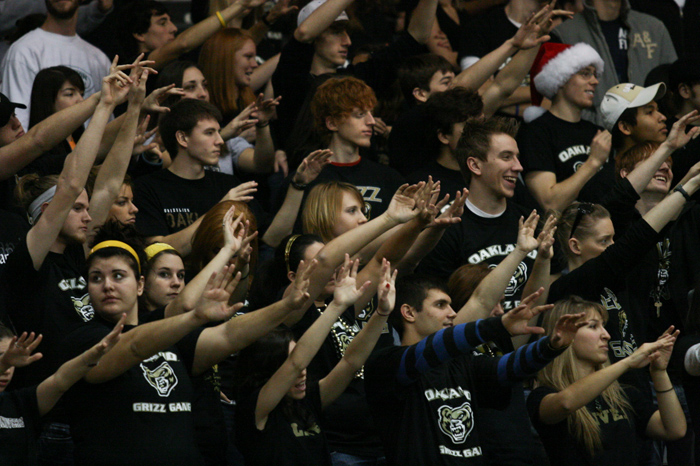
Fortunately, at Oakland University all of these facets have been coming together nicely over the past few seasons. University apparel has been made available at nearby supermarkets, and local businesses have slowly embraced the university's swag. Students, while never lacking the opportunity to obtain a free shirt at OU, still have a tendency to wear gear from other universities, but progress has been made at games and especially while in the student section. Black-outs have become the norm for students at big games, evidenced at last season's homecoming game against Oral Roberts.

Attendance figures as a whole have been great the past few seasons. The average attendance was steady in the mid-2000s before surging in the 2008-2009 season due to two games at the Palace of Auburn Hills that were counted as home games despite a larger crowd advantage for the visiting teams (Michigan and Michigan State). Still, the increase that season was good enough for second largest increase in the nation, and the opportunity to play home games at the Palace should not be discounted. This past season saw the largest growth sans a Palace game. Average attendance was 2,733, no doubt boosted by increasing student participation as well as community interest in a team that eventually won a conference championship and NCAA tournament bid. The sense of community emanating from the O'Rena is surely something to behold and a strong indicator of the program's current success.

This community sense has also been enhanced by technology. While he's yet to join the Twitter revolution like conference colleague Scott Nagy, Coach Greg Kampe gave fans insight into the team's preparation before every game on OUGrizzlies.com via video updates. For a team that does not receive regular attention on national or regional media outlets, such updates have been key in giving fans the inside scoop so many other schools have the privilege of receiving. Furthermore, the Oakland Press has been instrumental in giving access to fans through the efforts of beat reporter Paul Kampe and Doug Pemberton before him. They have found success in adapting with the times by offering a weekly video interview series known as Grizz Talk on their website. Credit should also be given to the student newspaper which has gracefully fulfilled its role of updating students on news and events regarding the program. Finally, fans have also been involved through a forum that features many dedicated supporters who discuss, analyze, and link to anything going on with the program. All great programs have such outlets for fan expression, and the Grizzlies community has come together to offer one of the best in the conference.

The commitment from administrators, students, alumni, and community members to Golden Grizzlies basketball has been growing over the years. Many will say that 2010's NCAA Tournament appearance was validation that the commitment and emotional investment was worth it. After all, OU was featured on the front pages of the Detroit News and Free Press and on FOX 2, WDIV 4, and Channel 7 throughout the days leading up to the game against Pittsburgh. There were also stories and breakdowns on any number of the national college basketball websites and blogs in cyberspace. And there was a buzz amongst fans on-campus, especially as 100 students boarded buses to attend the NCAA game in Milwaukee where the students, combined with family members, alumni, and other fans, made for a formidable OU support section. It was clearly a good time to be a Grizzly this past March, and the positive effects of that experience should continue to be seen in the future.

---

It is my hope that after reading these last few posts about The State of the Golden Grizzlies basketball that a light was given to some aspects of the program that are sometimes overlooked. I'd never want to bypass the impact that Coach Greg Kampe and the coaching staff, athletics staff, senior administrators, and donors make on the program. But the recent success the program has had in broadcasting, graduation rates, and community-building are paramount to this process as well. As a recent graduate, it is my hope that the OU program will continue on this exciting path which has brought the university more exposure in the local area, the state, and the nation. Most of all, it is hoped that the special community that has grown out of this basketball program can continue to be a rewarding and positive one which fosters more traditions, more friendships, and more everlasting memories.

Wednesday, May 12, 2010

The State of the Program: Part II

The following is the second part in a series about the state of the Oakland University basketball program. So often such addresses are delivered by the heads of state (or in this case, the program), but for today this is from the perspective of an outsider, a dedicated fan.

When the average person attends college, the goal is to obtain a degree. It is presumed that the degree will be valuable in the search for a meaningful and fulfilling job. In the realm of college basketball, however, it is debatable whether this is the true end goal. In the one-and-done era, especially, it has become increasingly common for student-athletes to completely bypass the former portion of that hyphenated word which press conference moderators love so much. These individuals are students only in the sense they are enrolled in classes. But how much time and effort is put into those classes? A recent report showed that such effort is minimal for the University of Kentucky basketball team, which featured four one-and-doners this past season, where the team GPA was just above passing.

The one-and-done phenomenon doesn't affect teams at the mid-major level as much, but there are still factions on such campuses who wonder about the work athletes put into school versus sport. As an Honors student and dedicated supporter of athletics during my time at OU, this was something I thought about on a consistent basis. The Honors student in me valued education first and foremost, but the basketball fan in me knew the athletes were denied certain opportunities I would have because they played Division I basketball. A major part of my time as an undergrad was shaped outside of the classroom by the activities I was involve in, the many communities I joined, and the jobs and internships I was able to partake in. In essence, I had a complete undergraduate experience.

While I'm sure any basketball player will tell you they too had a great experience, there is no doubt that the time they have to dedicate to the program severely limits opportunities: if you have practice during the day, it becomes difficult to secure an on-campus job; if you have summer workout programs, it's nearly impossible to land a summer internship; and if 75% of your non-conference schedule is on the road, well, it is really hard to establish meaningful relationships with professors. These are all things I had the opportunity to do as Joe College Student, and each one of them made me feel more connected to the university, boosted my pride, and eventually led me to spend a lot of time trying to spread that pride and sense of community to others.

The basketball program does that too, and the players are perhaps the most integral part of that process. They sacrifice the typical college experience for grueling practices, long flights, and even longer bus rides to lackluster places like Macomb, Illinois. Don't get me wrong, there are assuredly many perks that make the life manageable; these are gifted individuals with talents better than most who go to school for "free" (and no one is saying they don't have chances to have fun off the court), but it is still worth noting such sacrifices that many students often forget about when debating the merits of the student-athlete education.

What is important noting at Oakland University, as we evaluate the State of the Program, is that the student-athletes are graduating. While it is impossible to show what is behind the degrees they are earning, the simple fact remains that they are getting them. They are walking across the stage each semester with a degree in hand. Three starters from last year's team just graduated in May, making Coach Greg Kampe three-for-three for both his 2006 freshmen class (Johnathon Jones, Keith Benson, and John Kast) and amongst those who stayed with the program in his 2005 freshmen class (Derick Nelson, Erik Kangas, and Ricky Bieszki). Even as one of those players, Keith Benson, tested the NBA waters early (and eventually withdrew), he still had his degree in hand.

We can be sure that after four (or five) years under Kampe, these individuals are graduating as disciplined men. They are proven winners. Some may go overseas to play basketball for a bit while others may stay in the States seeking playing opportunities. But ultimately they'll end up in a position where their Oakland University degrees (and experiences therein) will come in handy. This fact is something all Golden Grizzlies fans should be proud of because there are not many schools that can boast about graduation rates. And it's also one more reason why it is a remarkable time to be a supporter of this program.

Monday, May 10, 2010

The State of the Program: Part I

The following is the first part in what hopes to become a series about the state of the Oakland University basketball program. So often such addresses are deliver by the heads of state (or in this case, the program), but for today this is from the perspective of an outsider, a dedicated fan.

When we talk about teams, we remember spectacular seasons and the players who made those moments possibles. When we as fans make an emotional investment in a championship season, we obtain a sort of immortality; we were a part of something bigger than ourselves, something that will live on in our memories and those of our children and grandchildren when passed on.

But when we talk about programs, we remember the institutions: the coaches. Coaches transcend the lifespan of players, and the truly amazing achieve their own immortality, not only in the minds of fans who were there for the ride, but for an entire society. We often forget, though, that there are others who achieve such standing, the ones who dictate what the coaches put on the court or field: the broadcasters.

In Michigan there is no broadcaster who has attained ever-lasting life like Ernie Harwell. He called games when fans had no choice but to tune in over their transistor radios. He called the good seasons and the bad ones. He was an institution within the Detroit Tigers baseball club. And the reverence with which people remember him in Michigan and around the nation surely cements his legendary status amongst society at large.

---

On the same night Harwell was remembered at Comerica Park, a new generation of broadcasters - Mario Impemba and Rod Allen - spent an inning talking Harwell with the legend's long-time partner, Paul Carey. Impemba was visibly excited about the opportunity to talk with Carey about Harwell as both have likely given him - and any aspiring baseball broadcaster - inspiration over the years. As their discussion closed, Carey told Mario he'd be looking forward to his calls of Oakland University games later in the year. It was an interesting note to end on, but clearly one prominent enough in Carey's mind to bring up on a regional broadcast of a Major League Baseball game. Impemba offered his thanks and cut to commercial.

Coming off a conference championship and an NCAA Tournament appearance, it is a remarkable time to have ties to Oakland University. Paul Carey, a legend in his own right, knew this enough to recognize Impemba's broadcasting duties with OU during what was surely a much-viewed Tigers game! Impemba, who began working with the Golden Grizzlies two seasons ago, has been a key figure in bringing OU basketball to a respected level in the metro-Detroit area. From his first to second year alone, the program made the move to a better radio station which provided opportunities for more coverage, including most of the road games during the 2009-2010 season. His connection to the program has also boosted content on the Fox Sports television arm, giving the university the ability to televise a few home games each year. Impemba has also published columns on the FSD website at various points throughout the season.

In short, Mario Impemba has become a key person in the movement to make Oakland University basketball a special, special entity here in metro-Detroit. Credit is of course given to the people who make these things happen (Gary Russi, Tracy Huth, Greg Kampe, etc), but at the end of the day, the fans only remember the person talking dimes and dunks.

Impemba, due to name recognition first but style and dedication thereafter, has the chance to be remembered here. He can be an institution at Oakland University, the guy who called the games during championship seasons and deep tournament runs in Sioux Falls or Tulsa or wherever the conference tournament ends up in future years. He'll never be as revered by as many as a guy like Harwell or Carey - at least in this sport - but those who are there, those making the emotional investment, will be there for him every step of the way so long as he is there for us.

Every great team has someone calling its games by which the dedicated hear and make sense of the action at hand. While great teams can help define a program, they are ultimately constrained by time. A great program, on the other hand, obtains continued success over the long-term, and by staying true to the program, through thick and thin, a great broadcaster can become an institution. Immortality achieved.

Saturday, May 1, 2010

Showing Off Benson

Last summer, Keith Benson was invited to participate in a summer camp hosted by the NBA's Amare Stoudemire for promising big men in the college ranks. There is no doubt that Kito's participation here helped bring some exposure to the big man from the small school. He worked out amongst the likes of Greg Monroe (Georgetown), Larry Sanders (VCU), Jerome Jordan (Tulsa), and Cole Aldrich (Kansas) - all potential draft picks in June's NBA draft. During the regular season, Benson was dominant against Aldrich, holding the future NBA baller to 4 points on 2 for 10 shooting. While Kansas' runaway win limited Cole's minutes in the second half, anyone who remembers the game knows Benson had an affect on his play during the first half.

It was after this game when scouts and NBA draft experts started to take notice of Benson since this was considered his first big game against legitimate competition. The only other time Kito faced a touted big man was against Charles Garcia of Seattle (5 points in 20 minutes), but he was covered by other OU defenders as well. Benson may have been tested by Syracuse's Arinze Onuaku in late December, but he played just five short minutes due to injury. The next test with superior competition came in the biggest stage of them all, the NCAA Tournament, against Pittsburgh. Benson had an amazing offensive game scoring 28 points, 10 of those from the charity stripe. Pitt's big, Gary McGhee, had a solid game for a team that received most of its scoring from its guards.

It has become clear over the past few months that NBA scouts and draft experts draw up much of their analysis based on performances against other players with NBA potential. This is why the Aldrich match-up is so highly referenced. Now that Benson has withdrawn from this year's draft, Greg Kampe and his staff have vowed to do everything they can to get the Oakland center to the next level. Paramount in this process is scheduling a few out-of-conference games against teams with physical big men who are already on the radar of NBA personnel. With that said, let's take a look at a couple of match-ups that would do well in showing off Benson's capabilities.

The Likely, Yet Unlikely

Devin Ebanks - West Virginia University
- Ebanks is a 6-9 forward who would be entering his junior year in Morgantown. The catch is that he has declared for this year's draft already, but has shown up on more than a few lists as one of those guys who would benefit from another year in school. Assuming he comes back, it is very likely that OU would be playing WVU this coming season as this match-up has been rumored since the end of the NCAAs. Ebanks is more comfortable than Benson on the perimeter and is capable of making his own play from 10-15 feet away from the basket. Kampe has talked about trying to give Benson more opportunities with his face to the basket, so guarding Ebanks would be a great way to see how he stacks up against a similar-bodied player with NBA potential. Likewise, Ebanks could stand to improve his post play and needs to prove he can be physical in the paint. Seems like a match-up made in heaven for scouts. It would likely happen if Ebanks stays, but it appears unlikely that will happen at this juncture.

JaJuan Johnson - Purdue University
- Johnson's decision to enter the draft early was a surprise to most. It was thought amongst most college basketball arbiters that Johnson would come back for his senior season with E'Twaun Moore and Robbie Hummel to give Purdue a three-headed monster destined for a Final Four appearance. Instead, both he and Moore declared early but without agents. So the door is still open for Johnson to withdraw his name (before May 8) and make possible this match-up with Benson as Purdue is another opponent that has more or less been unofficially confirmed for next year's schedule. Johnson is another guy who, like Ebanks, can play in the post in college simply because of his height, but will likely need to rely more on his perimeter skills and athleticism to get by in the NBA. Because of this, he's not the perfect match-up for Benson to showoff his post moves, but he is a good one for him to show he can guard guys with athleticism and skills that aren't anchored in the paint. Johnson's draft decision could go either way at this point, but my best bet is that we'll see him back at Purdue next year on what should be a loaded team. When the schedule is released, let's hope OU is making a trip to West Lafayette.

The Other High Majors

Draymond Green/Derrick Nix - Michigan State University
- It is almost a lock that OU plays MSU every year, so we can reasonably expect to see this match-up in 2010-11. Green is no lock for a double-double, yet he did it last season against OU and Benson. While Benson had a double-double of his own, it'd be becoming of him as a top performer to shut-down a guy with a bit more bulk, if not only around the waist. Nix is also a heavy guy who looks to slim down this summer in his attempt to be a more productive performer for Tom Izzo. Benson will get his shot at the MSU bigs as always, and while neither have NBA scouts watching as much as Benson, it's still a shot to prove he's got what it takes to shut down big program players.

Jared Sullinger - Ohio State University
- I have never seen Sullinger play, but everyone and their mother is in love with this guy's ability in the paint and his physicality. He is expected to start for the Buckeyes in his freshman year and is likely a one-and-done center for Thad Matta like BJ Mullens and Greg Oden before him. At 6-10 and over 250 pounds, he is bound to be a tough guy to guard on size alone. And if he has the skills and abilities that are being touted by the talking heads, then look for this guy to be in the same vein as DeMarcus Cousins. If such a match-up were to occur, one would hope that Benson's athleticism and wisdom would overwhelm the youngster. It'd also serve as motivation to show that a senior who has honed his skills over four years would be better able to make an immediate impact on an NBA squad than a one-and-doner. Considering OU's location and tendency to play Big 10 teams, a game against tOSU is possible but has not been rumored as of yet.

The Mid-Majors

Eli Holman - University of Detroit
This match-up would mean so much on so many levels. U of D will be loaded next year with Holman in the paint and McDonald's All-American Ray McCallum, Jr. running the point. These two teams have not played in quite some time, so a renewed home-and-home series would surely fuel the competitive spirit of metro-Detroit. Holman is a big time player himself; maybe not on many NBA draft boards, but still respected for his interior presence. He had himself a number of solid games last year and looks to improve this year. Holman-Benson would be the match-up of the the match-up. Let's hope it happens!

Brandon Bowdry/Matt Balkema - Eastern Michigan University
This one might draw some frazzled looks from readers, but rest assured, this one needs to - and if history is correct, most likely will - happen. Last season, OU started the year off with a home game against the Eagles, and they lost. It was a shocking blow to lose to a team OU had beaten several times before with many of the same pieces. OU's big-three all put up big numbers, but there were times when the Golden Grizzly big men had trouble with EMU's size. Brandon Bowdry went off for 26/13 and beastly Matt Balkema pushed around Benson whenever he was on the court. There probably isn't much to prove to scouts in a game like this, but rest assured that OU fans want to see a dominating performance from Benson and the OU squad as a hole after last year's disappointing loss.