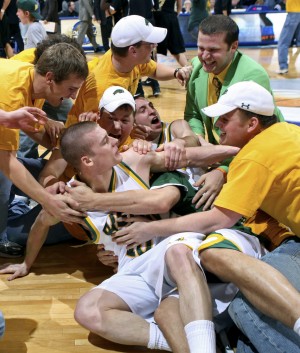
Wednesday, June 30, 2010
Student Section Chronicles: IPFW
Sunday, June 27, 2010
Student Section Chronicles: North Dakota State
Saturday, June 26, 2010
The Four-Year Player, The NBA Draft, And How It Looks For Benson in 2011
When Keith Benson declared early for the draft this spring, it was a bittersweet moment for Oakland University fans. If Benson were to be drafted, it would be a huge win for the program. At the same time, losing the reigning Summit League Player of the Year would no doubt leave a big hole in the Golden Grizzlies' front-court. A thumb injury made it impossible for Benson to participate in some of the pre-entry deadline workouts, meaning he would not be able to receive enough immediate feedback to make a sound decision about whether to stay in or out of the draft. Due to these circumstances, Benson announced he'd return to school for his senior season, poised to defend his conference honors.
For the past few drafts, specifically, seniors have been falling further down draft boards than ever before. This year's version saw Trevor Booker go at #23, the longest it has ever taken for the first senior to hear his name called. While the end of the first round was more kind to seniors than the first 20 or so picks, this is no doubt a trend to be worried about when it comes to Benson's first-round potential next year. The key for any player is to be a first-round pick because then a contract is all but guaranteed. Fall to the second round and there are no sure things, meaning great college players like Varnado and Jordan may not ever see an NBA court, despite hearing their names called on draft night. At this point - and it is early - it seems unlikely that Benson would go undrafted in 2011, given how the already-mentioned similar players and seniors fared this year. He's got too much talent and size to be where Brian Zoubek and Omar Samhan were on Thursday night. But to get a first-round guarantee, he'll have to continue to prove he has the skill, motor, and strength to be mentioned amongst the first 30 picks.
What is clear at this point is that there won't be as many big men to choose from in 2011. Soon-to-be-freshmen Perry Jones, Jared Sullinger, and Enes Kanter are lottery locks if they come out early, and Jonathan Givony and Gary Parrish even have a guy like John Henson (6-10, 200 pounds) as a top-30 prospect. I guarantee Benson will post better and bigger numbers and display more intensity than Henson next year, but Henson has the all-important "upside" that NBA scouts love so much. Aside from these possible early-entrants, the rest of the crop is rather slim, JaJuan Johnson (Purdue) and Kenneth Faried (Morehead State) leading the bunch. Both explored going out early this year but ultimately chose to return for their senior seasons. Benson is a better fit at center in the NBA than any of these players who may play the "5" in college but are being scouted as power forwards. And Benson has the skills to be more than just a back-to-the-basket center. His ability to impress scouts paired with slim pickings at his position bode well for Mr. Benson in 2011.
Tuesday, June 22, 2010
The Student Section Chronicles
We've done our best to track down student representatives from all of The Summit League schools, and where current students were unavailable, recent alums or employees have stepped in. Still, we may not have reports from all 10 schools, but a solid majority should be represented by the time all the posts are churned out. We hope what follows is a close-up look at the entities which make college basketball games fun events for students to attend every season.Sunday, June 20, 2010
Breaking Down The APR
In 2005 the NCAA established the Academic Progress Rate, or APR, to measure a university's success rate in retaining and keeping eligible its student-athletes. Scores are released for every team at every university, and they are based on a rating of up to 1000 averaged over a four-year period of time. The NCAA's benchmark for success is 925, meaning any score below this number is grounds for penalties. Since it is a relatively new system and four-year averages are being accumulated for the first time, penalty precedents are just now being established.Fortunately for fans of Oakland basketball, there is nothing to worry about as the Golden Grizzlies have thus far been securely above 925. The new data was recently released, figuring in the 2008-2009 year into the four-year average. The Oakland University men's basketball team had a four-year APR of 962, while the single-year APR for 2008-2009 was a resounding 981.
So what exactly does this mean? Well, the APR is a rather simple measurement. Essentially, a team can receive up to 2 points per scholarship player per semester. One point is achieved if the player is academically eligible for the next semester, and another if the player returns for that semester (or graduates). Last season, for example, the men's team would have received four points total for Erik Kangas since he stayed eligible in both semesters, returned, and eventually graduated. Since Kangas was just one of 13 scholarship players on the team, a little math will reveal how many points are possible for the entire team:
13 scholarships x 2 points x 2 semesters = 52 points
Using this total, we can find the details in the 2008-2009 APR for the Oakland's men's basketball team. As seen in the table to the right, OU's 981 is actually only a single point shy of a perfect score. The lone detriment was the transfer of Matt Samuels. Since Samuels did not return to Oakland for the following semester, he only earned one point of a possible two for the winter semester. This is the only possible scenario I could work out for the missing point, which means that all 13 scholarship players stayed academically eligible in each semester for the 2008-2009 year.The other case where a player would not earn a point is if he left early for the NBA Draft. For the longest time, most probably would not have envisioned this hurting Oakland, but it could have been a distinct possibility for next year's APR had Keith Benson stayed in the draft as an early-entrant. Since he was a redshirt on track to graduate, I am unsure of how this would have affected OU's APR. But it does begin to bring about the question of flaws with this measurement.
The most glaring weakness in the APR is that it penalizes a school if a player transfers out of the program. Players transfer for a number of reasons - sometimes over playing time, sometimes due to a bad fit - but it should not play a role in determining whether a team is meeting academic goals. Yet, the rule exists and does not appear to be going away anytime soon, so OU fans can expect the APR to be below 1000 each year given the program's tendency to have at least one transfer every year. Next year, for example, the APR may be 981 again because of the transfer of Jay Thames (and assuming the rest of the team stays academically eligible).
As for using the APR to compare institutions, there is yet another major concern. The NCAA does not set universal standards for determining eligibility; therefore, a player who earns a point at X university for staying eligible may not have been worthy at university Y. As a result, attempting to compare academic success based on this measure would be difficult to do accurately. However, the APR can be used to compare stability, where stability is a measure of how well a program has been retaining its players. (Note: The NCAA does not make available how each point was accumulated, so we have no way of telling if points went unearned because of ineligibility versus retention. But with a little deduction and other knowledge of the programs, a general picture can be painted).
Stability is something many fans have hoped to achieve in The Summit League, where universities have come and gone as often as coaches and players. The four-year APR average is not pretty, either. Four programs were under the 925 satisfactory level, and two were well under 900. Together, these totals bring The Summit League average to a paltry 929. Things are looking up, however, as most programs have posted improvements for 2008-2009 alone where the 10-team average was 949. Oakland's 981 is second only to Western Illinois' perfect 1000. Here are the full results:
By comparison, the Horizon League posted a four-year average of 956, and not a single program was below 925. Clearly, the Horizon League has achieved the kind of stability - not to mention on-the-court success - that should be envied by programs in The Summit League. Other thoughts, in bullet form:
When Jim Molinari took over the Western Illinois program, many thought he would bring to life the perpetually weak basketball team. While the Leathernecks have continued to have their fair share of troubles on-the-court, it is clear Molinari is building his program the right way. An APR of 1000 means he did not lose a single player, nor were any of them failing in the classroom. Expect further improvement by the folks from The Other Macomb.- NDSU and SDSU show again why they have been such solid additions to this league by posting very respectable APRs.
- Dane Fife seems to be doing a solid job in Fort Wayne. If he sticks there, his program will surely break out of the .500 funk they've been in for quite awhile. If he leaves for greener pastures (which seems to come up a lot these days), the IPFW program would probably lose much of the stability it has found under Fife.
- Oral Roberts and IUPUI are interesting studies. ORU has always had its fair share of impact juco transfers, and the APR reveals perhaps one of the reasons why is because it loses a few transfers itself every year. IUPUI, on the other hand, looks to be in shambles. This is not surprising considering some of the recent penalties they have faced. It would be great if one of the League's best programs on-the-court could find some stability off of it, though.
- UMKC's 2008-2009 APR is no surprise. Typically schools will suffer a bit in this measurement when coaching changes occur, but it is unreal how unstable the program has been even three years after Matt Brown took over. Do not expect improvements in the UMKC APR next season as three more players recently left the program.
- What is going on at Southern Utah? What exactly are they doing for The Summit League? I typically try to remain impartial or at least positive here, but can we please boot them from the conference already?
Monday, June 14, 2010
Looking At Basketball Revenues
All this talk of conference expansion as of late has been focused on one thing: money. In college athletics, much of the revenue universities take in comes from television contracts which are largely constructed around football. Basketball really doesn't mean much in this discussion, though money is certainly important when it comes to success on the court. Programs with large football revenues can funnel funds into other athletics, one of the reasons why the pigskin is such a prominent feature at schools above The Red Line. Schools below that famous line, those without booming football departments, have a proven disadvantage that transfers from ledgers to hardwood when playing those above.But what about within their own conferences? Do larger budgets make for stronger programs, even when apparently on the same level? The answers to these questions can be partially answered thanks to a recent article from CNN which breaks down revenues and expenses from every Division I men's basketball program. Specifically, we'll take a look at programs in Oakland's conference, The Summit League. Before looking at the numbers, it's important to note one fault with them:
The comparison between basketball revenues and profits is interesting, but not precise. That's because schools have latitude in their filings with the Department of Education in whether they attribute some expenses and revenues to a specific sport or a more general classification for their entire athletic department.Despite the lack of a universal accounting method, the numbers are still revealing. Even ignoring the profit margins, one can obtain a general idea about the amount of money each school makes and spends on men's basketball (data sometimes hard to obtain across the board considering private institutions do not have to make public their financial information). Here is a look at the financial factors for the 10 Summit League programs:
Many schools use that latitude to have revenue and expenses for one sport equal one another rather than show a profit or a loss, a trick of accounting that wouldn't pass muster with the Securities and Exchange Commission.
What strikes me immediately about the information above is that Oakland University was the only school reporting a profit from men's basketball in the reporting year. While it is impossible to draw many conclusions from that considering how different departments handle their accounting, it is interesting nonetheless. It confirms the thought that OU's basketball program has done rather well for itself in recent years, especially when compared to some other programs (IUPUI, UMKC, SUU) reporting significant losses.The data also gives us a general idea of how much money each team is bringing through revenues. Since actual budgets are difficult to obtain, this revenue data can give us a decent starting point for comparing program successes based on budgets (since budgets are estimated based off revenues). With that, here is a look at the amount of revenue each school took in compared to number of conference wins:
It would be challenging to make any definitive statements based on this graph. Generally, the schools generating close to or over $1 million had the most success in this year. UMKC is the one exception. Other thoughts, in bullet form.- UMKC is the most captivating case in this study. Not only did they generate more revenue than all schools but Oral Roberts, they also spent the second most (over $2 million) on men's basketball. There could be some odd reporting on the university's part, but what remains is an unpleasant picture: a program generating and spending close to $2 million and winning only 3 conference games as a result. UMKC has largely been a bottom-feeder in the Summit League the past few seasons, but it spends a significant amount on the sport which serves as an outlier to the common thought that more money wins more games.
- NDSU operates at an incredibly efficient level. The books were balanced in this year, and they took home a conference championship. While the 2009-2010 numbers probably look a bit different, there is no doubt that NDSU brings to the conference a very solid model.
- It is my hunch that ORU and Oakland will be near the top of the conference in dollars generated and spent every year. It's no coincidence, then, that they are also in a race for a conference championship every year. While money is not the only reason why they've been successful, their continued success has allowed them to expand their budgets which gives them an advantage over many peer institutions.
- The group of teams in the middle seems about right, given their competition level in men's basketball over the years. IUPUI is worth noting as a school that lost a whole lot of money on the sport in 2008-2009. They don't make much on it, either, ranking dead last in revenues. Future data would be needed to see if this was a one-year abnormality or if the program truly lacks the financial support of others. If the latter is so, the university deserves props for fielding a competitive club year-in and year-out.
Oakland vs. Detroit Almost Happened
It's no secret that Oakland University's basketball schedule will feature five to six household names every year when it is released. Fans have become used to Coach Greg Kampe's scheduling philosophy, some happy with the opportunity to play big-time schools in big-time arenas, others disgruntled over the fact that these games always end in a loss. No matter how fans feel about that aspect of the non-conference schedule, many would agree that there is one team they would love to see year after year: the University of Detroit.OU and Detroit have not met on the court for a men's game since the 2003-2004 season (a 60-76 loss at Calihan Hall). There hasn't been much in the way of an official reason as to why, but a little searching and it's easy to find out why fans from both sides believe the hiatus has occurred. No matter the case, it appeared as though the match-up would be resurrected this year with both teams fielding impressive line-ups. However, from the Washington Post, we learn the long-awaited return of OU v. Detroit has been sidelined again:
It all comes down to what coaches call self-preservation and the need to serve their own self-interests. Kampe, the Oakland coach, said his scheduling challenge is easier than most because "I don't care." After 26 seasons at the school and with strong job security, he tries to win the Summit League and schedules a who's who of power-conference teams in nonleague road games, record be damned. Next season's slate includes West Virginia, Tennessee, Illinois, Purdue and Michigan State (at a neutral site).While this report would have one believe Detroit canceled because of fear of playing a Benson-led Grizzlies team, it is impossible to prove, especially sans a statement from the Titans. Moreover, it's unfair to put the blame solely on Detroit here. The Titans clearly initiated this process, and while it is unfortunate that the game couldn't go ahead as planned, there could be a multitude of reasons why it ultimately got nixed. The least of which should be Benson, as Detroit returns double-double threat Eli Holman, a big man poised to break into All-Conference territory in the Horizon League this season. (And sadly squashes one of the match-ups we most wanted out of this season's schedule).
But there are still issues. Kampe has had trouble scheduling Detroit. Finally, after Oakland center Keith Benson declared for the NBA draft, Detroit called and asked to start a series; Kampe agreed. The next week, Benson withdrew and the phone rang. It was Detroit, saying they have a scheduling conflict.
"That's the crap that happens," Kampe said.
No, what we have here is yet another incident where two programs run into trouble when trying to plan a schedule. As the Washington Post article points out, it is incredibly tough to schedule at the mid-major level. As Oakland fans know, the result of such difficulty in this process results in a lot of guarantee games instead of matches against other quality programs at this level. Hopefully the communication which has occurred recently between Oakland and Detroit is a sign that the tides are turning in favor of a renewed series between the suburban and urban school. Such games would surely drive the competitive spirit of the respective fanbases, and perhaps the casual basketball fans of metro Detroit, too.
Aside from the Detroit news, we get further confirmation of several rumored match-ups from this article. Purdue and Michigan State have been confirmed for a few weeks now. Adding Illinois and an expected game against Michigan makes it four matches against Big 10 teams, which should do wonders for Oakland's RPI and strength of schedule considering how strong the conference is expected to be this season. Tennessee and West Virginia return solid squads coming off an Elite Eight and Final Four, respectively. While several integral pieces from those runs are gone, they should still be strong contenders and tough games for Oakland on the road. The schedule is shaping up nicely, and hopefully the finalized product will still yield a few surprises.